I
am fascinated that so many seemingly dissimilar people worldwide are
ardently working towards the common goals of individual liberty,
self-ownership, and nonaggression. As liberty is moral, practical,
peaceful, and universally beneficial, it makes sense to libertarians
that people should feel this way. But it still inspires me to find
how widespread this sentiment is, even among those who do not
self-identify as libertarians.
Many
of us believe that we can make our lives on this planet better, more
peaceful, fairer, greener, and more prosperous by returning to a
society based on individual rights and by establishing a truly
free-market economy, free trade, and a foreign policy of
nonintervention. To this end, millions
have optimistically involved themselves in the growing world-wide
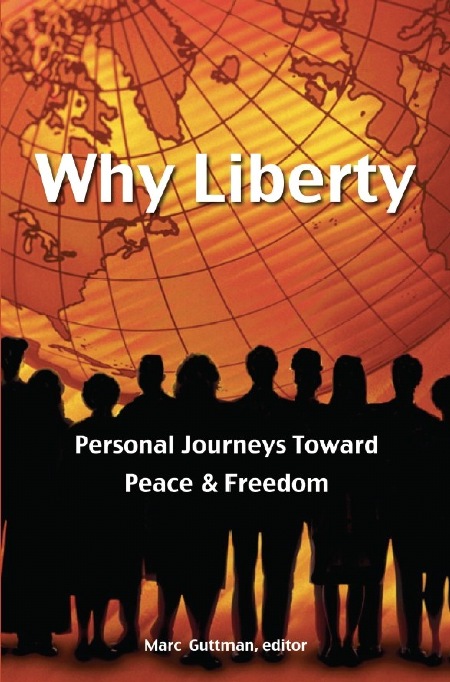
liberty movement. This volume is a collection of some of their
stories. The contributors are from many corners of the world and
from different walks of life. Their personal experiences are
illustrative and mind opening.
For
me, like most people, as an easy-going, younger adult, I took
little interest in politics. I would much rather be backpacking or
snowboarding than discussing political theory or involving myself in
a political movement, let alone trying to convince anyone of
anything. Government and politics had little to do with me and I
never thought to want anything to do with it. Little did I know.
Learning through personal experiences and from the stories of others,
I now realize that people, through government force, involve
themselves deeply with each of us. Most often the legislation of
politicians harms us, and harms the least well off of us the most.
My lessons really
began when I was most free. I was 21, had graduated college, and
was, for the first time, self-sufficient. Soon after my final exams,
I traveled on a one-way ticket to Africa and solo backpacked through
a dozen countries for half a year. It was easy for me to feel
liberated and inspired while hitchhiking through sub-Saharan Africa,
where you can often pitch a tent where you stand, purchase meat from
anyone on the street, and on the ground few rules seem to exist. At
least they didn’t seem to exist for me as I was not endeavoring to
prosper in Africa. Rather, I felt confident, self-aware, and
excited. I enjoyed my experiences and the pleasant way and easy
smiles of the Africans I met along the way.
Unfortunately,
Africa is not a land of freedom in many important ways. It’s funny
that I realize this even more now than I did while traveling there 13
years ago. For the most part, individual
Africans have few rights that can be defended against the might of
government or against the whims of local strongmen and bureaucrats.
Many African countries have brutal histories of war, slavery, and
oppression. While there were signs of political activity (in a
remote village, I traded my “University of Virginia Wrestling”
t-shirt for a man’s “Uganda Presidential Elections 1996”
t-shirt, off each other’s back), and people showed strong support
for their preferred candidates, it seemed that governments were often
an obstruction to people’s prosperity. I was not savvy enough at
that young age to inquire about details, but I do remember talks with
local people trying to get businesses going, who faced impenetrable
bureaucracy, graft and bribery, and prohibitive costs and
regulations.
A few times, I
sensed a fear of government. I remember a Zimbabwean man grabbing my
shoulder, alerting me not to move as President Robert Mugabe’s
motorcade rode past in Harare, because I risked being shot at by his
military. I was not allowed to pass into Rwanda, because fleeing
refugees were flooding in from warring Zaire. While hiking on the
border of Zaire and Uganda, I was turned back by my local guide,
because of evidence of violence in the area. I was later told that a
village had been burned nearby in a civil-war-related incident. I
will leave it to the African contributors in this volume to better
elucidate the issues of Africa’s governments.
It was on returning
home that the contrasts were clearer to me. I immediately
appreciated how behavior is dictated and obstructed here. A few
people have asked sincerely, “In what way are we not free? What
can't I do, that I want to do?” It is said a frog thrown into a
pot of boiling water will immediately jump out, while a frog in a pot
of water that is slowly brought to a boil will remain to be cooked.
Perhaps it is still too subtle now for some to appreciate, but
everyday I see all around authoritarian signs and usurpation of our
freedoms. When old-timers reminisce about “how things used to be,”
I find myself missing a time I never knew.
I was in San
Francisco soon after returning to the States, when I learned about
the then recently passed first-time legislation banning
private-property owners of bars and restaurants from allowing patrons
to smoke cigarettes on their property. Many of
us are used to such regulations now, but at the time it came as a
shock.
Every
day, laws and regulations stop you from making decisions for
yourself. They decide where you can and cannot travel, when you must
use personal protective equipment, what you cannot eat, drink, and
smoke, what you are allowed to drive, what you cannot sell and buy,
how much you are to get paid for a service, who is not allowed to
provide services, to whom you must provide services, what dietary
supplements and medical therapies you may choose for yourself, and so
on. Laws prevent dying people from taking new investigational
medicines at risk to nobody but themselves. Right now there are an
untold number of people being imprisoned, without due process, by the
US government on US soil and overseas that have not been charged with
a crime. The Real ID Act has been passed and soon Americans will have
to present their papers to be allowed the privilege to travel
domestically. Citizens are spied upon by government officials without
legal warrant.
One common
realization that leads people to self-identify as libertarian is the
truth that you can only have freedom by giving it away. That is, the
only way one can be free to follow one’s own endeavors and
interests, is to allow others the same freedom to follow theirs. It
also means we should not be forced to support the ideas and endeavors
of others. People who do not understand this will often ignore the
infringements on others’ liberties that do not affect their
personal interests or the public funding of activities that interest
them. Surely, at some point, their personal choices will be outlawed
and they will be forced to support that to which they are most
opposed. This is why it is important to promote the individual
rights of everyone, rather than community rights, special interest
rights, or corporate rights.
In the years since
that youthful trip in Africa, I have studied the damage to us caused
by government’s laws. The forgotten truth is that government was
accepted by the people living in the North American colonies only for
the purpose of protection against force and fraud and that government
was not meant to be important to our lives. This is now far from the
reality. Heck, I hate having to take any of this so seriously, but
once one realizes that government force is being used by our
neighbors against each other, it is hard to ignore.
In our often
well-intentioned attempt to solve more quickly the few problems
suffered by any free society, we have created wider-spread,
deeper-rooted and longer-standing ones. This volume is a collection
of specific personal examples of these. I am often bothered by
recurring realizations of how much more prosperous and happier most
of us would be now, if we had not burdened ourselves with the heavy
fist of government.
In attempting to
improve the lives of laborers, thousands of pages of regulations make
employers less able and willing to hire people. This, in turn, makes
it harder for many to provide for themselves and their families. The
effect of minimum-wage laws, one example of domestic trade
restrictions, is that of discriminating against the employment of
non-union and lower-skilled workers. Since employers understandably
will not pay an unwarranted wage for lesser-quality services,
individuals suffer unemployment and consumers pay more for products
and services.
Workers around the
world have the fruits of their production taxed away to fund the
interests of others. Corporations and individuals benefit unfairly
from favorable legislation that drives out competitors and harms the
consumer. Economist Milton Friedman called protectionism “a
good label for a bad cause,” because it really meant exploitation
of the consumer. He further explained that special interests have
proliferated restrictions on the products and labor we can buy and
sell. The gain to one industry's producers from tariffs or subsidies
is more than offset by the loss to other producers and to all
consumers in general from the tremendous array of restraints that
have been imposed.
Individuals
and organizations ought not be restricted from trading freely,
regardless of their nationalities. The goal of non-coerced
transactions is mutual benefit. Cooperation, not conflict, promotes
peace, freedom, and economic welfare. When individuals seek special
favor from their government, either through subsidies or trade
restrictions, individuals in other industries and countries feel
compelled to seek the same. History proves that aggressive trade
policies lead to political frictions and violent conflict.
Several economists
have contributed to this volume and will help the reader appreciate
some of these basic economic principles and their importance to our
prosperity. It is prosperity that enables us to
educate our children, provide for our health care and safety, nourish
ourselves with healthy foods, protect our environment, and engage in
the activities in which we delight.
Because of our
innate compassion, we have tried to help struggling neighbors through
public assistance programs. Thousands and their children, no longer
responsible for providing for themselves, have lost the skills and
motivation to do so. Several essays in this volume attest to this by
way of examples from the authors’ personal experiences with
loved-ones affected by the entitlement system.
In trying to protect
people from themselves, we have imposed on people's rights to
self-ownership and privacy. People who are not harming anyone are
not allowed to choose their behavior freely, even in choosing
potential medical therapies for themselves. Recently, a 16 year old
cancer patient was ordered by the court to receive chemotherapy
treatments that he and his parents had deferred for another therapy
they had researched and chosen. Other patients must wait years for
potential therapies to be approved by the FDA before they are allowed
to use them. Why did we decide it was okay for others to limit our
freedom in choices of personal health care?
A pharmaceutical scientist, a medical system designer,
and three physicians have provided examples within this volume
describing the many adverse effects of our medical therapy and
licensing regulations.
Our nation’s drug
wars have spent trillions of workers’ money, have cost the lives of
many innocents, and have made communities violent, with no
improvement in the destructive affects of drugs on individuals and
society. A state Superior Court judge, a law enforcer and a medical
marijuana patient discuss drug prohibition and illustrate its
negative ramifications.
Going well beyond
matters of defense, either in the interest of aiding others or in
making resources available to themselves, countries have adopted
aggressive foreign policies, intervening with neither a moral
justification nor reasonable authority. Military interventions have
caused the upheaval and destruction of the lives of so many millions
of families. In studying world history, it is clear that aggression
begets aggression and blowback. Despite popular arguments to the
contrary, war most always impoverishes most everyone, except of
course those trading in the war industry. And, we allow the taxing
of our personal income to support it. A former Lieutenant Colonel in
the US Air Force and political-military affairs
officer in the Office of the Secretary of Defensediscusses the downside of US foreign policy and
interventionism. A lifetime peace activist weighs in as well.
Governments have
become the largest and nastiest polluters of our planet, while
enacting environmental policies that are ironically harmful to the
environment. A researcher and consultant on environmental issues, a
foresting consultant, and an environmental lawyer examine in this
volume the shortfalls of centrally-planned environmental policies
both in the US and in Europe.
Families’ homes
and property are seized by government and given to others. A victim
of eminent domain abuse and her lawyer discuss the seizure of her
property and their day in the US Supreme Court. Another contributor
discusses obstructions to her building on her property and home
business by her neighbors’ efforts in zoning legislation.
A disheartening
result of our attempt to solve our problems through force is the
discouragement of ingenuity and entrepreneurialism, the ingredients
of self-satisfaction and economic development. Rugged individualism
is no longer encouraged and the human spirit has dimmed. What's
more, government-enforced mandates usually have a way of turning
would be cooperative participants into adversaries. Aggression has
unbalanced us in every way.
The universal goal
of the people in my profession is: First Do No Harm. As an emergency
physician, my goal is to advise people on how to make the most
appropriate medical decisions for themselves. The risk-benefit ratio
of every diagnostic test and therapy is considered. I use my
understanding of medicine to avoid harming my patients. This edict
of “First Do No Harm” was the principle upon which the United
States of America was founded. Our constitution was to ensure that
people cannot use government power to harm, steal from, and coerce
others. This is the Nonaggression Principle.
Today, government power has grown out of all proportion, and it is
mostly used by people who are well placed to harness it for personal
gain, rather than for its original purpose which was precisely to
protect us from being fleeced by such people.
Consumers have enjoyed the benefits of lower prices and better
quality in products and services offered by the least regulated
industries. As health care is amongst the most heavily regulated
industries, consumers have much less choice in both medical insurance
coverage and care. Thus, people are finding it more and more
difficult to access affordable health care.
The motivation of
medical providers is tested as they are forced by unfunded mandates
by the federal government to provide care to those unwilling or able
to pay for services. Health care providers frantically ensure that
they follow every complex and tedious regulation out of fear of large
fines and possible imprisonment. Health-care facilities spend
hundreds-of-thousands of dollars a year to insure government-required
protocols are followed. This also necessitates the hiring of dozens
of full-time employees. This is so that providers can receive the
below board reimbursements for patients covered by public medical
care programs. All of this significantly raises the cost of
providing medical services for everyone.
Listening to older
physicians, it would seem the physician-patient relationship has
become strained. Patients feel more entitled and have high
expectations, and defensive health-care providers and facilities are
held to standards that are difficult to achieve.
One
would hope all of this mandatory spending and work at least in some
way improves the quality of care provided to patients. But it appears
that it is mostly a waste of effort and resources, and that it
actually gets in the way of much-needed innovations in health care.
There
is not, unfortunately, a free market in health insurance.
Government policies have been to create the nonsensical coupling of
health insurance with employment, mandatory balloon coverage, and
restrictions on obtaining insurance policies from insurers outside of
one's state. While
seemingly a good thing for many people, these policies have had the
unintended consequence of limiting coverage options for most. In
addition, the tax code only allows businesses, not individuals, to
deduct the cost of health insurance premiums. The effect is that of
dramatically shrinking the consumer base, causing the medical
insurance industry to have little incentive or ability to provide
more customizable and affordable products.
These
interferences also prevent the practice of discounting policies for
people with healthy life habits, those who exercise, stay trim, avoid
smoking, alcohol, and other drugs, eat healthy, and take dietary
supplements. These discounts would further encourage good physical
and mental health.
At the end of my
medical school training, I enjoyed a trip to south Asia (India,
Nepal, and Tibet). I had a limited, but self-affirming, six week
experience while working at St. John’s Medical College Hospital in
Bangalore, India. This medical center is a private Christian-based
institution.
Despite most
patients being of significantly little means, it was explained to me
that every therapy, every single pill, intravenous line and fluid,
diagnostic study, etc. was line itemized in the patient’s bill
which was paid out of pocket. Unlike most of my practice in the US,
the patient was truly the consumer and every medical decision was the
result of an important discussion, as you can imagine.
I asked the staff
why patients would not seek the “free” services available at the
public hospital, to which I received rolled eyes and looks of
revulsion. I was lead to believe that care received at the
government hospital was poor and patients often needed to bribe staff
to receive it and comfort items. To what extent this is true, I do
not know, but many poor locals make the decision to use part of their
limited resources to receive medical care at the private hospital.
Libertarians judge
legislation based on whether it imposes restrictions or burdens on
individuals who are not affecting another individual's equal rights.
Economics teaches us that central-planning produces results inferior
to those of free people acting to improve their lives. Even
well-intentioned legislation more often has negative unintended
outcomes that are unfortunately ignored in mainstream discourse.
Some people believe
government force can be used successfully if the right people are put
in charge of it. If the right people are in place, they argue, then
the privileged power of government will not be abused and programs
will perform more efficiently and successfully, with little adverse
outcomes. These people accept any loss of rights and freedoms to the
individual who is not harming anyone as an acceptable trade-off.
Government is made
up of people no more special than you and me. Unfortunately, many of
the people in government use the privileged power of government to
advance their agendas. They are encouraged to do this by large
voting blocks, corporate interests, labor groups, and other special
interests. The end result of this process is various types of harm
done to all of us.
World history has
shown us that only in a truly free society will individuals who want
to increase their personal wealth and well-being have the
opportunities to do so. Such a situation, where we have an increase
in our standard of living, allows for people, either as individuals
or through non-coerced cooperation, to be better able to help others
who are having difficulties providing for themselves.
So, in the end,
after a dozen years of reading, researching, and writing on these
issues, I, like most libertarians, dislike politics more than ever.
I look forward to the time when government has little to do with
anything except protecting us from force and I can again consider it
little. My friends and family will be happy then to not receive so
many political emails and videos from me.
The authors of this
volume have shared with you unique experiences that convinced them
that liberty and limited-government (and for a few not even that
much) is the best way for men and women to govern themselves. I
expect you will find this volume as educational, entertaining, and
inspiring as I have.
Marc
Guttman 2009
Marc
Guttman is an emergency physician, currently living in Connecticut
with his wife and children. He would much prefer to spend his time
with them and playing outdoors than endeavoring to reverse the damage
of aggressive governments.